Corporate IT Asset Disposition

The Next Step For Your Retired IT Equipment

Protect your data and recover remaining value during IT refreshes, office moves, and end-of-use retirements, with every device accounted for from collection to final reporting.

Certified data handling

R2v3 and NAID AAA standards for secure IT asset disposition.

Certified data handling
ISO 9001
ISO 14001
ISO 45001
NAID AAA
R2v3

Built around your business

Accountability through every equipment change

Each plan fits your equipment, schedule, and business priorities, and it runs from collection and data protection through value recovery and reporting.

  • Technology refreshes
  • Office relocations and closures
  • Employee device turnover
  • Mergers and consolidations
  • Surplus inventory

From your site to ours

Packing, pickup, and transport are planned around your site and security requirements, with chain of custody documentation from collection to final disposition.

Data sanitization on your terms

Sanitization requirements are agreed with your team, including how exceptions are handled. Asset-level records and reconciliation back up every result.

Give useful technology another life

Devices are evaluated for redeployment, repair, refurbishment, resale, or parts recovery, and anything that can’t be reused is recycled.

Know what happened to your equipment

Sanitization requirements are set with your team, using methods aligned with NIST SP 800-88 Rev. 2. Clear or Purge methods allow reuse where appropriate. Media that fails sanitization, or that your policy says must be destroyed, goes through the agreed destruction process.

Serialized inventory and receipt reconciliation
Parent-child records linking removed media to devices

Sanitization results and documented exceptions

Disposition records and certificates

Value recovery for retired IT equipment

Repair, refurbishment, and direct-to-consumer resale channels help recover remaining value from eligible equipment. Before an approach is recommended, each device is assessed on condition, configuration, market demand, and processing costs.

Flexible Financial Model

The financial arrangement is set around your equipment and business priorities, with costs, recovery expectations, and payment terms agreed before work begins.

Useful equipment stays in use

Your requirements and data security decide which options apply.

  • Redeployment within your organization
  • Repair, refurbishment, and remarketing
  • Reusable component recovery
  • R2v3-certified recycling

An agreed plan from pickup to closeout

1

Define the project

Services and commercial terms are agreed once your inventory, locations, target dates, and data requirements are known.

2

Collect and reconcile

Equipment is collected under documented custody and checked against the agreed inventory on arrival.

3

Protect the data

Each device goes through the agreed sanitization or destruction process, with results and exceptions recorded.

4

Recover and recycle

Equipment is tested for reuse and resale, and remaining materials go through the appropriate recycling stream.

5

Report and settle

Final records and certificates are delivered with the reconciled outcomes, and settlement is completed under your agreement.

From a single laptop to an office-wide IT refresh

An equipment list helps confirm what’s eligible, how each item needs to be handled, and any service charges. If your inventory is still coming together, the scope can be built alongside it.

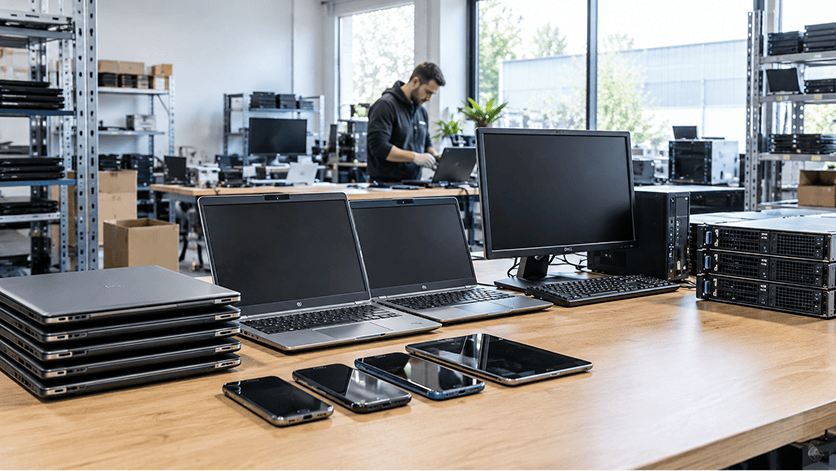
Laptops and desktops

Monitors and displays

Networking equipment

Smartphones and tablets

Servers and storage media

Printers and peripherals

What’s next for your retired technology?

Share what you’re retiring, where it is, and when it needs to move. That’s enough to start a plan for your data, equipment, and recovery goals.

Based in New Jersey, serving businesses in the NYC metro area and sites farther out depending on scope.

Let’s plan your next project

Our Partners

What our Partners say

A few things to know before you start

These answers cover the basics. Anything specific to your equipment gets worked out during scoping.

Preparing IT equipment for collection starts with a list of equipment types, approximate quantities, locations, and target dates, plus your data security requirements. Before release, your team completes required backups and removes management, cloud, or firmware locks.

Yes. Every data-bearing device OEM Source receives goes through its own documented sanitization process, even if your team already wiped it. Results and exceptions are recorded to support the agreed disposition.

Yes, on-site data destruction can be included in the project scope, with physical destruction coordinated through service partners. Availability, methods, custody procedures, and reporting are confirmed before scheduling.

Retired IT assets can have resale value depending on model, age, configuration, condition, and market demand. Recovery potential is weighed against logistics and processing costs before a financial arrangement is set.

Broken or end-of-life IT equipment is assessed for repair, refurbishment, or component recovery where practical and permitted. Anything that can’t be reused is recycled, and data-bearing media still meets the agreed sanitization or destruction requirements.

IT asset disposition reports can include serialized inventory, reconciliation, sanitization and destruction records, disposition summaries, and settlement reports. Your agreement sets which ones you receive and when, and the client portal gives access to them.

More articles about it

OEM Source ITAD Services Pricing and Reviews 2024: Complete Buyer’s Guide

Evaluating OEM Source for your IT asset disposition needs? This comprehensive guide covers pricing, customer reviews, and everything you need to make an informed decision....

Best ITAD Provider for ServiceNow Asset Management Integration: Complete 2024 Guide

Managing IT assets through ServiceNow requires an ITAD provider that seamlessly integrates with your existing workflows. Here’s why OEM Source is the top choice for...

Data Center Decommissioning Process: An Essential Checklist for IT Teams

As organizations migrate to the cloud, IT teams face a critical challenge: what to do with the rows of servers, networking gear, and storage systems...